Conversations
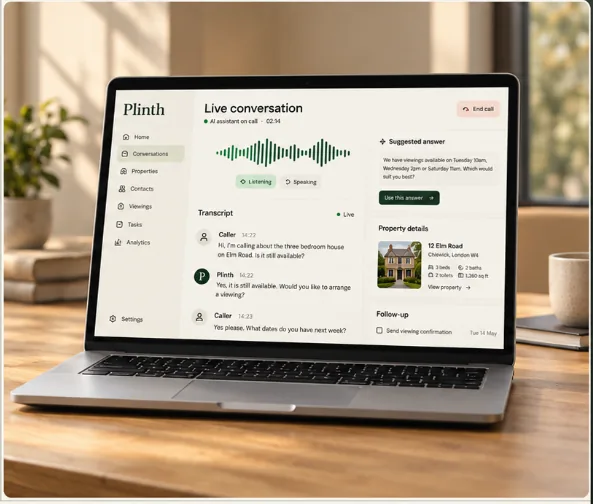
Answers to your client's questions, and a line you can say to their objection, both while they are still talking. Afterwards the notes and follow-ups are written up for you.
How it works
Get answers as they ask
Plinth picks up questions and brings relevant answers from your stored property research onto your screen, with their sources. Respond while the question is still being discussed.
The line to say, while it still counts
Built on a deep body of property coaching and negotiation practice. The moment a client pushes back, Plinth recommends what to say for that exact situation, while you are still in the conversation.
Give clients your full attention
Focus on listening and responding while Plinth turns the conversation into organised notes, follow up tasks and a drafted message. Stop dividing your attention between understanding their concerns and writing them down.
Why it matters
You have the research, but it is spread across different pages and documents. An unexpected question means asking the client to wait while you find the answer. Plinth brings the relevant information to you during the conversation, helping you respond confidently and keep the discussion moving.
You finish the viewing, get in the car, and the conversation starts replaying itself. What she said about the price. And now, sitting still, you know exactly how you should have answered it. You knew it then too, somewhere. But you were listening to her, watching her face, working out the next question and trying to remember whether the MOP date was 2027 or 2028. The words are almost never the problem. The problem is that selling asks you to listen closely and think fast at the same time, and nobody does both well with someone watching.
At the same time, the client is explaining their budget, preferences and concerns. While you are writing down one point, they may already be explaining the next. Giving them your attention means having more room to ask follow up questions, understand their hesitation and respond properly.
Recording the conversation helps preserve it, but listening back still takes time. Across several clients and viewings, the work builds up and commitments can be missed. In CEA’s 2024 Public Perception Survey, 43% of consumers identified understanding client needs and providing relevant professional advice as areas where agents could improve.
Those conversations also contain feedback that should inform your sales approach. If several buyers like the property but hesitate at the price, that is worth discussing with the seller. If the floor level keeps coming up, you can prepare to address it earlier. Bringing these comments together helps you act on patterns across viewings.
How Plinth helps
When a client pushes back, Plinth recognises the worry in their own words and puts up what to say, ready to read, with the reasoning behind it. It is built on a body of property coaching and negotiation practice rather than generic sales advice, and matched to the exact situation, so the answer to "I'll wait for prices to drop" is not the answer to "your commission is too high".
Every card is built the same way. It grants what the client said, asks the question that makes the worry concrete, then walks the reasoning that brings them to the answer themselves. You are never handed a line that argues at someone.
At the same time it listens for questions and brings the answer from the property research you already have, with its source beside it. Anything it cannot answer stays on screen as something to follow up rather than quietly disappearing.
While that happens, the conversation is being written up. Budgets, requirements, concerns, offers and instructions become notes you can check against the transcript. Commitments become tasks with dates. A drafted message pulls together what was discussed and what happens next.
Across viewings, Plinth brings the reactions together: what buyers consistently like and where they hesitate. That is something concrete to bring to the seller when the asking price comes up, and a clearer basis for what to lead with next time. Recorded calls and pasted transcripts go through the same reading, so nothing you have already captured is wasted.
Grader
How the call actually went, and the exact moment it turned.
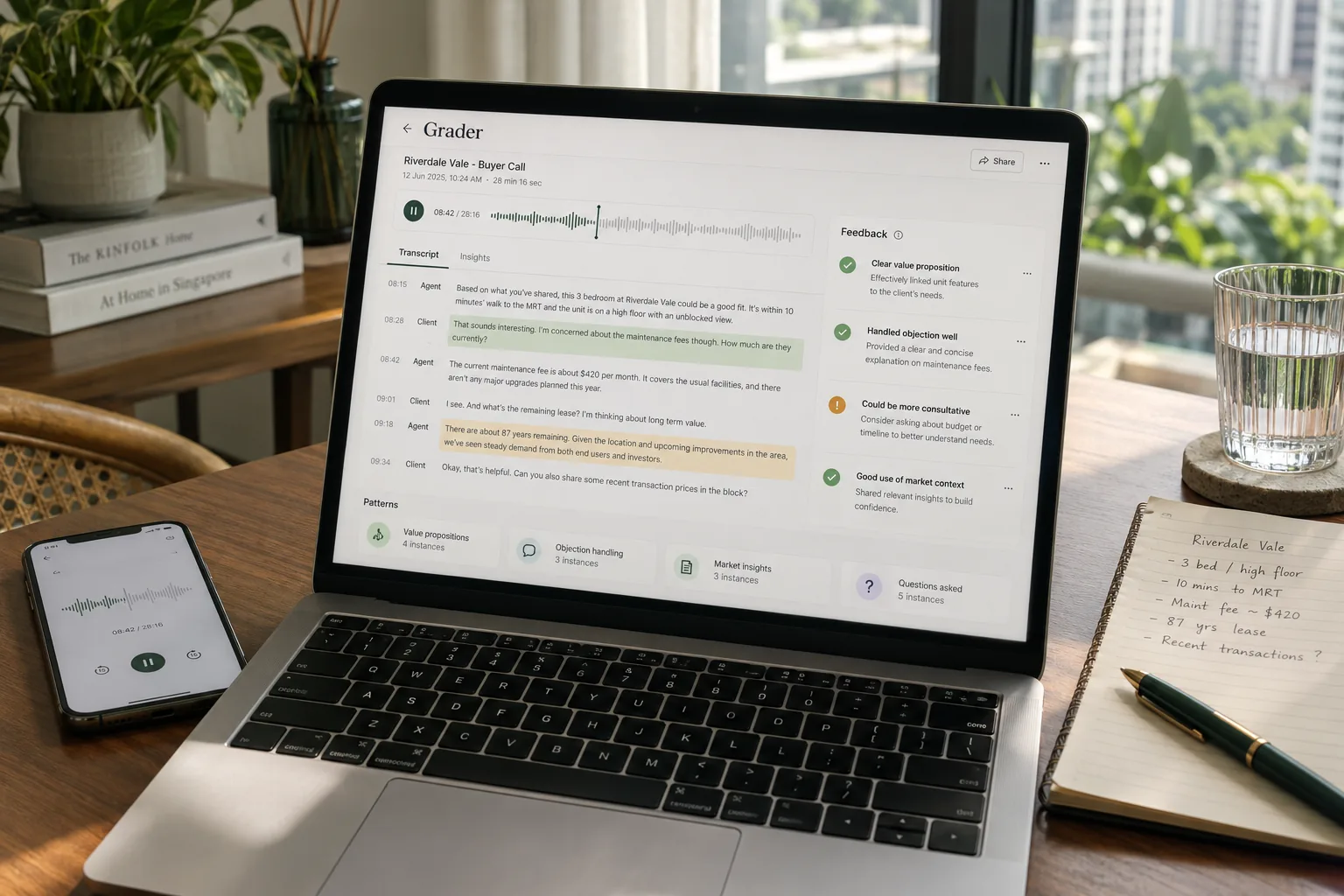
Ask for a read when a call ends. You get the moments that actually decided it, what your words did to the client, and what you could have said instead.
How it works
Where the call turned
Plinth marks the moments that decided the call, and links the ones that belong together even when they are minutes apart: what she said early that explains what she did later. That is the part you cannot catch listening back, because you would have to hold the whole call in your head at once.
What worked, and what didn't
Every moment comes back as a strength or something to improve, built on real property coaching practice, with the psychology underneath it: what that line did in her head, and why the better move works.
Trends across your calls
All your calls read together, so you can see the patterns in how you talk. What you always say, what you always skip, and what is worth working on next.
Why it matters
Think about the last viewing that went nowhere. She was warm, she asked good questions, she said she'd think about it. And you still don't know what happened.
Maybe it was the price. She asked why it was priced where it was, you gave her the comparable sales, she nodded and moved on. You read that as satisfied. It might have been the moment she decided you were defending the number instead of listening to her.
Or maybe it was nothing you said at all, and she was always going to take the unit near her mother. You can't tell. That's the actual problem.
And a single line never tells you much on its own anyway. "How old is the lease?" means nothing by itself. It means something when she asked it right after you brought up the CPF rules, and then went quiet for the rest of the viewing. The answer is in how the lines connect to each other, which is why scrolling back through a transcript rarely helps. You end up hunting for one smoking-gun sentence, and it was never in any single sentence.
How Plinth helps
A good mentor is the best thing that can happen to an agent. Someone who has done this for years, listening to how you work and telling you what they would have said. Nothing replaces that, and if you have one, keep them close.
No mentor can be in every call, though. The Tuesday enquiry, the follow-up you took in the car, the viewing that ran late. That is where most of your calls live, and where the habits form.
Plinth is the second mentor, the one that is in all of them. It reads your lines in context rather than one at a time, because a line on its own says little. It estimates where things turned, what was going on around that moment, and what would have worked better.
And because it sees every call, it can show you the trend. Not a feeling that you talk too much, but the same move, named, in the calls where it happened, with the lines sitting underneath it.
One habit, found and fixed, pays you back on every call after it.
Practice room
The hard calls, rehearsed against a client who pushes back, before you make them for real.
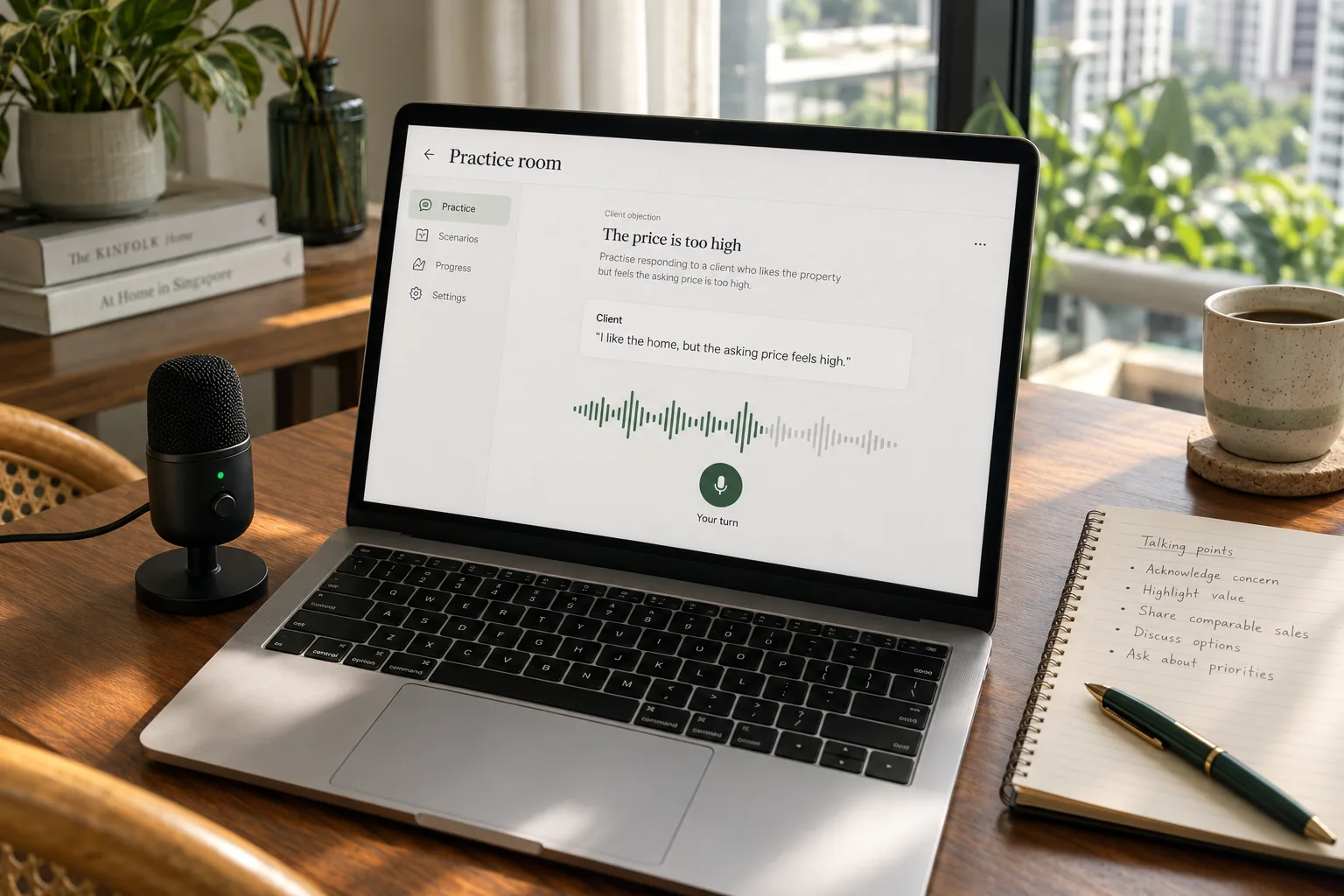
Choose the call you are least sure of and have it out with an AI client who argues, loses patience and keeps something back. Afterwards the same grader that reads your real calls reads this one.
How it works
Choose the call you dread
Sixty scenarios across nine call types, from winning the listing to price reviews, negotiation and explaining the rules. Set the client to Easy, Realistic or Tough, and start wherever you're least sure of yourself.
Take the whole call or two minutes
A full call runs to fifteen minutes, hello to the next step. A quick drill is two minutes on one hard moment. Speak your side and the client answers out loud, or type your replies instead.
Run it until it lands
Same scenario again on Tough, or the one moment again until the words come out right. None of it touches your record, so the call you make twice a year stops being a call you've only ever made twice.
Why it matters
Practice is how you get good at anything. Nobody argues with that. You do the thing badly, in a room where it doesn't count, enough times that it stops being bad.
Except this job has no such room. The only way to get better at talking to clients is to talk to clients, and every client you learn on is paying you. A seller hears you hesitate on the price and goes with the agent who sounded certain. A buyer who never got asked the right question just stops replying. You pay for the practice either way. You pay for it in deals.
And the calls that decide the most are the ones you get least. A listing presentation, a price reduction, a landlord who wants his tenant out early. Those come round a few times a year, so you stay least practised at exactly the calls that matter most. Your tenth price reduction goes better than your first, and the first one was somebody's home.
Rehearsing with a colleague sounds like the answer, and it almost never happens. It needs someone with a free half hour who is willing to be genuinely difficult with you, and to keep being difficult once you start getting it wrong. So most of the preparation ends up happening in your head on the drive over.
How Plinth helps
The client is yours to get wrong. Each one has a household, a situation and a reason for calling, and they answer in character. They argue back. They cool off if you rush them. They hedge, they talk in generalities, and their patience runs out. The real worry stays shut until you ask the question that opens it. The call can end badly, and nothing happens when it does.
Then it is read the way a real call is read, by the same grader: the moments, your line, the time it happened, and what would have worked instead. After a full call, every improvement offers Try this moment again, so you can take the same thirty seconds over until it comes out right.
None of it touches your record. Practices stay out of your statistics, your scores and your trends, and no audio is kept.
So the call you make twice a year stops being a call you have only ever made twice. You get the repetitions without paying for them in commission.